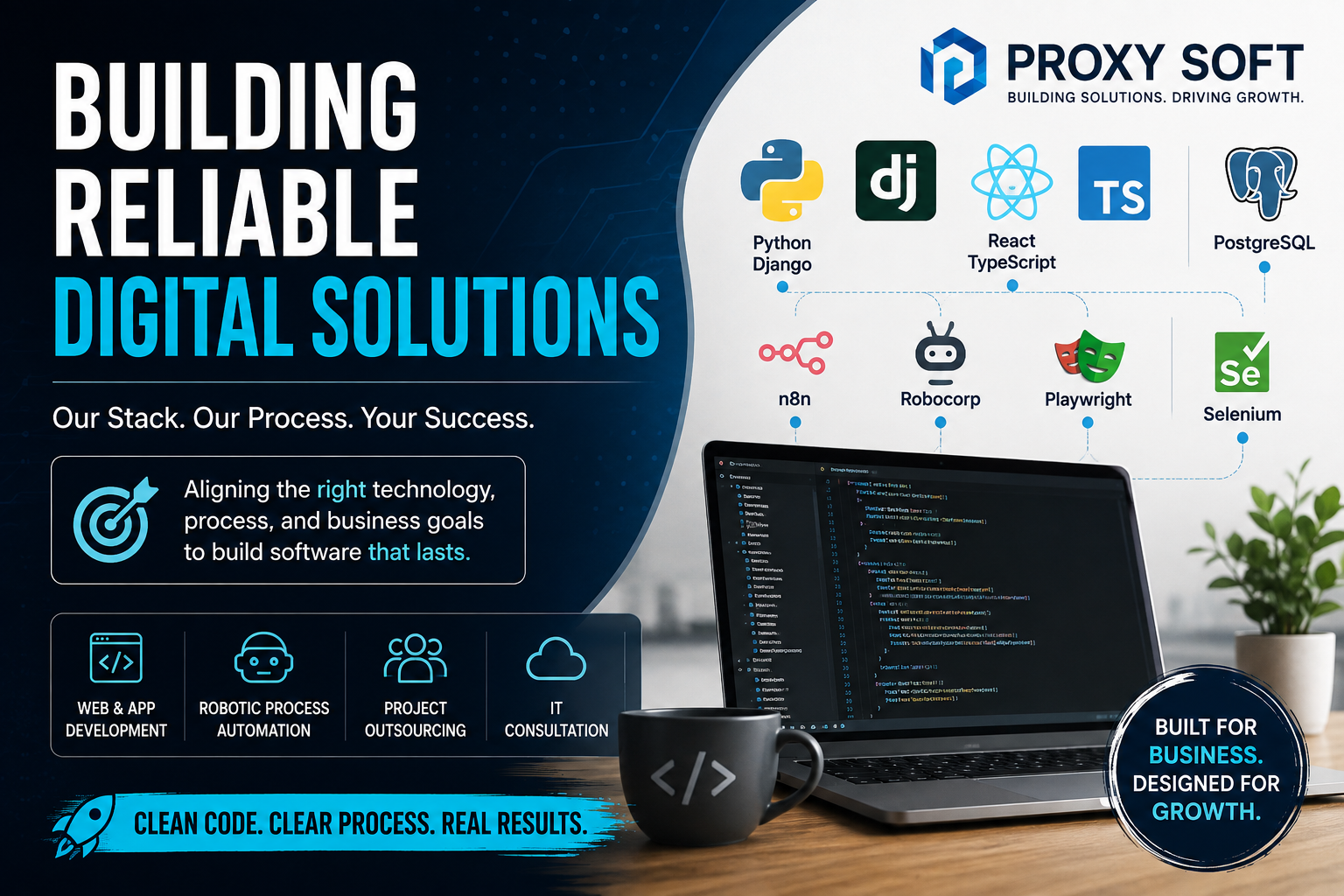
Most software projects don’t fail because a framework is “wrong.” They fail because the stack, the process, and the business problem never line up. At Proxy Soft, we treat technology as a set of tools with jobs to do — not as a badge of modernity. That is why our day-to-day work sits on a familiar, battle-tested foundation: Python and Django for durable backends, React and TypeScript for clear interfaces, PostgreSQL for data that must stay consistent, and a practical automation layer with n8n, Robocorp, Playwright, and Selenium when people should not be doing the same click-and-copy work twice.
This article is a longer walk through that approach. If you are a founder, product owner, or IT lead evaluating a custom build, a rewrite, or an outsourcing partnership, it should give you a concrete sense of how we think — and what you can expect when you work with us.
What “product and solution” really means for us
Proxy Soft is a Nepal-based team that helps organizations replace fragile manual processes with software that is clear, reliable, and easy to own. Our services are deliberately broad enough to cover a full journey, but focused enough that we do not pretend every engagement is the same:
- Web and app development — backend APIs, modern frontends, mobile and desktop when the workflow needs them
- Robotic process automation — agentic workflows, n8n integrations, Robocorp bots, and browser automation with Playwright
- Project outsourcing — dedicated squads or staff augmentation with transparent communication and agile delivery
- IT consultation — architecture, cloud, security, and roadmaps tied to business outcomes
Underneath those offerings is one preference: ship something maintainable. Fancy demos that nobody can operate six months later are not a win. Documentation, error handling, and a stack your team can hire for matter as much as the first release.
Why Django still earns its place in 2026
Django is not new, and that is part of the point. When you need authentication, admin tooling, forms, permissions, migrations, and a clear project structure, Django gives you a coherent default instead of a shopping cart of packages glued together late at night.
We reach for Django when clients need:
- Business logic that will grow beyond a simple CRUD prototype
- Admin surfaces that non-engineers can use without a separate “ops app”
- Security-conscious defaults for sessions, CSRF protection, and password handling
- A codebase that mid-level engineers can read without a two-week archaeology project
Python sits beside Django for good reason. Data work, automation scripts, API clients, and machine-assisted workflows all speak the same language. That reduces handoffs between “the web team” and “the automation team,” which is often where projects quietly leak time.
What Django is not for
We are honest about boundaries. If you only need a marketing brochure with almost no backend logic, a lighter CMS or static site may be enough. If you need ultra-specialized real-time event streaming at massive scale from day one, we may layer Node.js services or dedicated workers beside a Django core rather than forcing every concern into one process. The goal is fit, not ideology.
The frontend people actually use: React and TypeScript
A strong backend without a usable interface is unfinished work. We build modern frontend experiences with React, and we prefer TypeScript when the UI has enough moving parts that plain JavaScript starts to hide bugs until production.
In practice that means:
- Component patterns that stay consistent across pages
- Accessible forms and navigation, not only polished visuals
- Clear contracts between API responses and UI state
- Performance habits that respect Core Web Vitals instead of shipping megabytes of unused script
Node.js shows up when we need API gateways, realtime helpers, build tooling, or services that sit comfortably in the JavaScript ecosystem. We do not force every backend into Node, and we do not force every UI into React. We choose what your team can support after we leave.
PostgreSQL: the quiet hero of reliable products
If Django is the application spine, PostgreSQL is often the memory that keeps the business honest. Relational integrity, transactions, and mature tooling beat “we’ll fix the data later” almost every time for operational systems.
We design schemas with growth in mind: indexing for the queries you will actually run, constraints that prevent invalid states, and migrations that can be reviewed like any other change. Fancy database choices are interesting. Predictable backups and restore drills are what save weekends.
Shipping and running it: Docker and AWS
Code that only works on one laptop is not a product. We containerize with Docker so environments stay closer between development, staging, and production. On the cloud side, AWS is a common home for our clients — compute, managed databases, object storage, networking, and monitoring — but we size resources to the workload instead of copying a generic enterprise diagram.
Consultation engagements often start here: what do you already run, what is overbuilt, what is under-observed, and what would a sensible next six months look like? Cost control and security baselines are part of that conversation, not an afterthought sold as a separate package.
Automation that respects how people work
Custom software is not the only lever. Many organizations already have CRMs, spreadsheets, email inboxes, ERP screens, and partner portals. Connecting those systems — or automating the boring path between them — can unlock more value than a brand-new app.
Our automation toolkit is intentional:
- n8n for visual, maintainable workflows that connect APIs, email, sheets, and internal services
- Robocorp for structured back-office and ERP-style bots where reliability and audit trails matter
- Playwright for modern browser automation when a portal has no clean API
- Selenium when existing suites or legacy environments still need browser coverage
We care about failure modes. Automations should retry thoughtfully, log clearly, and escalate to a human when something looks wrong. A silent bot that “usually works” is a liability wearing a productivity costume.
How these pieces become solutions, not a pile of tools
Here is a simplified picture of how engagements often land:
1. Custom web platforms and internal tools
Django + PostgreSQL power the domain logic. React + TypeScript deliver the day-to-day interface. Docker packages the app. AWS hosts it with monitoring and backups. The result might be a client portal, an operations dashboard, a content-backed marketing site with a real admin, or a multi-tenant SaaS MVP.
2. Process automation beside the product
Once the system of record exists, n8n and Robocorp can move data between tools, generate documents, sync statuses, or prepare reports. Playwright steps in when a third-party website is the only interface available. The product and the automation reinforce each other instead of competing.
3. Outsourcing and dedicated delivery
Some clients do not need advice about frameworks; they need capacity. We plug in as a dedicated squad or as staff augmentation for backend, frontend, QA, and DevOps roles. You keep visibility through shared boards, demos, and a clear point of contact. The same stack preferences apply: maintainability over clever shortcuts.
4. Consultation before a big bet
If you are mid-rewrite, mid-migration, or unsure whether to automate or rebuild, we help you choose. Architecture reviews, cloud readiness, security baselines, and prioritized roadmaps are useful precisely because they reduce expensive thrash later.
A human process, not a slide deck
Tools do not replace conversation. Our delivery rhythm is deliberately plain:
- Discovery — goals, constraints, success metrics, and what “done” should feel like
- Architecture and stack fit — what to build, what to integrate, what to automate
- Iterative delivery — working software in short cycles, not a big reveal after months of silence
- Hardening — tests, accessibility, performance, and security checks that match the risk
- Launch and ownership — documentation, handoff, and support options including responsive help when production needs attention
We are Nepal-based and oriented toward international collaboration. That means overlapping hours where they help, async updates where they do not, and communication habits that treat your product as shared work — not a black box.
SEO and content systems: why the stack matters beyond “features”
Many of our clients care about discoverability as much as functionality. A Django-backed site can own clean URLs, structured metadata, sitemaps, and editorial workflows without bolting five plugins onto a fragile theme. Pair that with a fast React experience where interactivity is needed, and you get pages that are both useful to humans and understandable to search engines.
The same discipline applies to blog and knowledge content: clear titles, honest excerpts, readable headings, and internal links to services and contact paths. This article itself is written that way on purpose.
Common questions we hear
Can you work with an existing codebase?
Yes. Many projects start with a review of what you already have. Sometimes the right move is a careful Django upgrade and cleanup. Sometimes it is extracting an automation layer before touching the core app. We prefer evidence over a rewrite-for-rewrite’s-sake.
Do you only use Django?
No. Django is a strong default for many product backends, but Node.js, React, Flutter or React Native for mobile, and automation-first stacks are all in play depending on the problem. The homepage tech stack you see — Python, Django, React, Node.js, PostgreSQL, AWS, Docker, TypeScript, Playwright, Robocorp, n8n, Selenium — is a map of what we use most often, not a prison.
How do you handle support after launch?
Production systems do not wait for office hours. We offer support models that match how critical the system is, with clear escalation paths so issues are handled quickly and documented.
When you should talk to us
Reach out if any of these sound familiar:
- You need a custom web or mobile product and want a team that will still care about the code next year
- Your staff are drowning in repetitive portal work that could be automated safely
- You want an outsourcing partner who communicates like a teammate, not a ticket queue
- You need architecture or cloud advice before committing budget to a rewrite
We are glad to start with a short discovery conversation, map constraints and success metrics, then propose a scoped approach with timeline and investment options.
Closing thought
Technology choices are easy to romanticize and hard to live with. Django, React, PostgreSQL, Docker, AWS, and a thoughtful automation layer have earned their place in our work because they help real teams ship, sleep, and iterate. If that is the kind of partnership you want, contact Proxy Soft and tell us what you are trying to make more reliable.