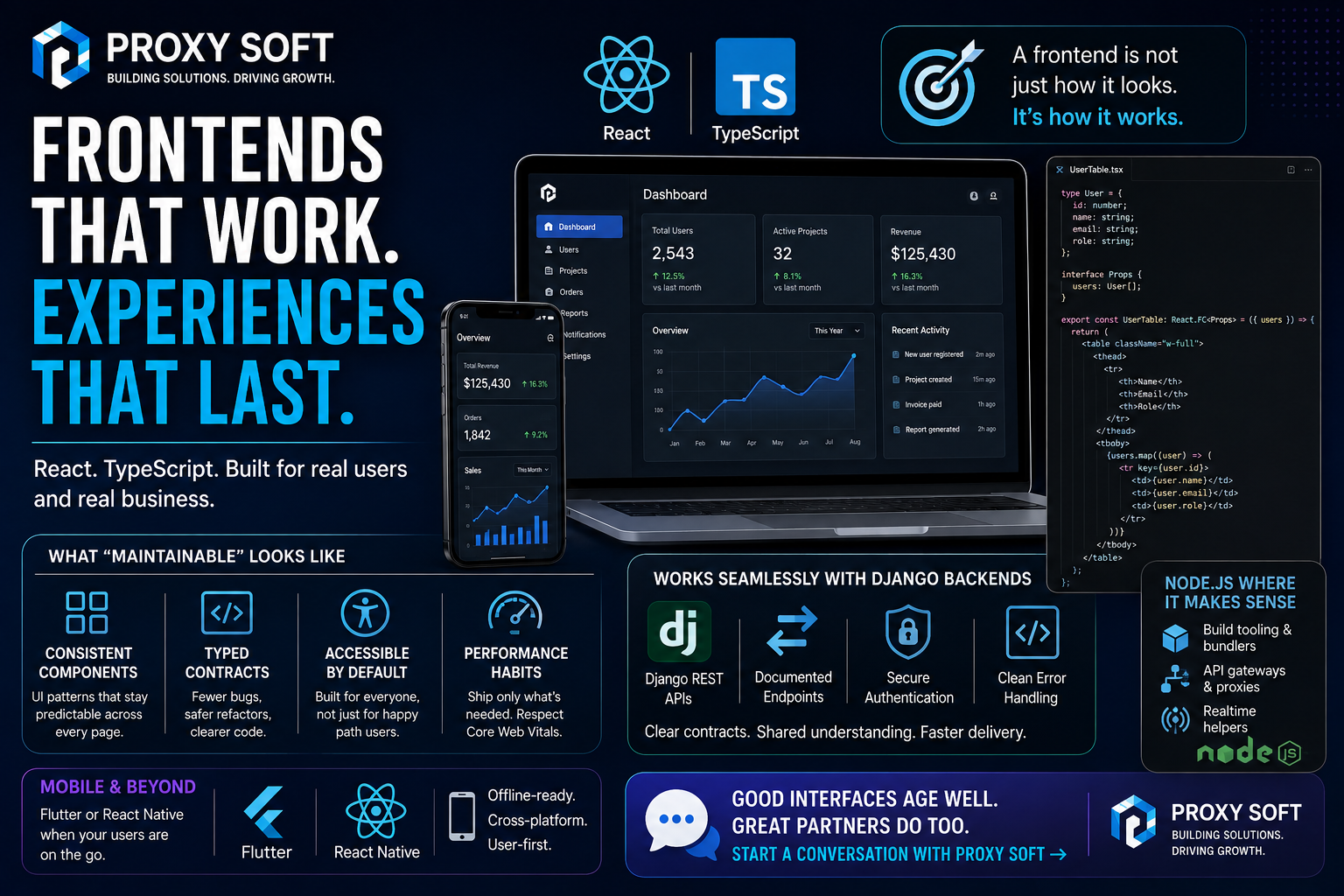
A backend can be perfect and still feel broken if the interface fights the people using it. That is why our product work treats the frontend as part of the solution — not a coat of paint applied at the end.
At Proxy Soft we build many client-facing and internal interfaces with React, and we reach for TypeScript when the UI has enough state and API surface that plain JavaScript starts hiding bugs until a user finds them.
What “maintainable” looks like in practice
- Consistent components — buttons, forms, tables, and empty states behave the same across pages
- Typed contracts — API responses and UI models stay aligned so refactors do not become archaeology
- Accessible defaults — keyboard flows, labels, contrast, and focus states are not optional polish
- Performance habits — ship what the page needs; respect Core Web Vitals instead of bundling everything “just in case”
Working with Django backends
Most of our React apps talk to Django (or Django REST-style APIs) as the system of record. That split keeps business rules close to the data while letting the UI iterate quickly. We document endpoints, error shapes, and auth expectations so frontend and backend work does not drift into conflicting assumptions.
Node.js still appears where it earns its keep: build tooling, lightweight gateways, or realtime helpers. We do not force every concern into React or every API into Node.
Mobile and beyond
When the workflow needs pockets and offline moments, we extend into mobile with approaches like Flutter or React Native — chosen for the product, not for a portfolio checklist. The principle stays the same: clear ownership, readable code, and a handoff your team can live with.
Need a frontend partner who will still care about the component library next year? Start a conversation with Proxy Soft.